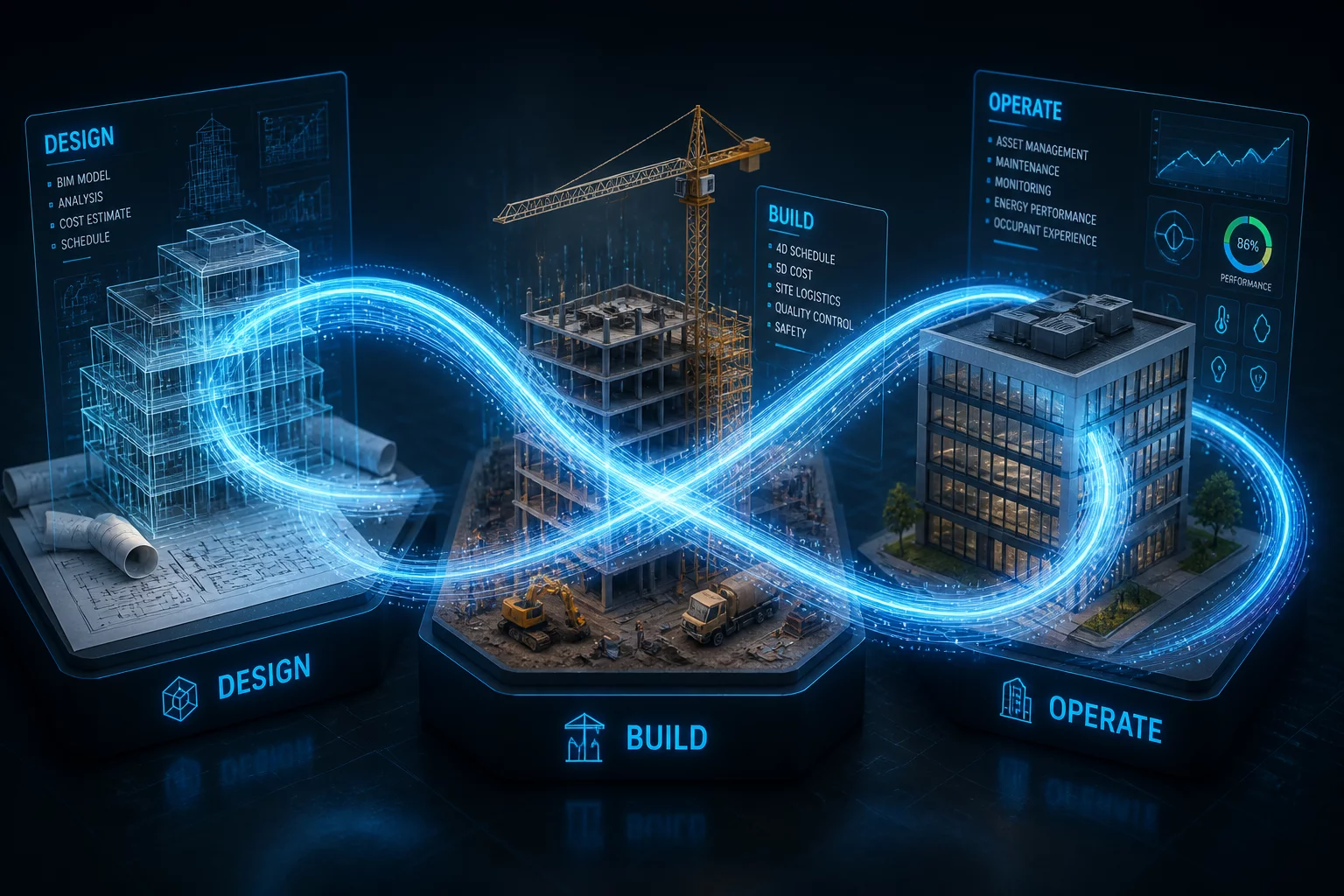
Construction projects suffer from a persistent and expensive problem: information decay. When a project moves from design to procurement, and later from construction to operations, critical context vanishes. The standard practice of compiling a massive closeout package of PDFs and spreadsheets at the very end of the build does little to solve this. Real alignment requires a continuous digital handover—a process that captures metadata, decisions, and physical changes in real-time as they occur on site.
The Pitfalls of the Traditional Batch Handover
In most traditional builds, handovers are treated as a single milestone event. Subcontractors submit their warranties, operations manuals, and as-built drawings during the final weeks of the schedule. This creates a bottleneck. Information is often missing, drawings do not reflect actual field adjustments, and the reasoning behind design deviations is completely lost. The operations team receives a digital dump of unorganized files, forcing them to spend months reconstructing the building’s history.
Building a Better Flow: The Continuous Approach
A continuous digital handover changes the timeline. Instead of saving data collection for the end, teams capture asset data and context at every phase transition. When a subcontractor installs an HVAC unit, they register the model number, warranty, and field changes immediately. This ensures that the digital twin of the building grows in tandem with the physical structure itself.
1. Capturing Decision Context
It is not enough to document the final state of an installation. Teams must record why a specific change was made. Was a pipe rerouted due to an unforeseen structural beam? Was a material substituted because of supply chain delays? Storing the communication history alongside the building model ensures that future maintenance teams understand the physical reality of the asset.
2. Standardizing Data Exchange
Different trades use different software. For a continuous handover to work, the project must rely on open data standards and unified formats. Standardized fields for equipment, locations, and system relationships prevent data from getting trapped in proprietary systems.
3. Defining Ownership Thresholds
Handoffs succeed when ownership is clear. At each phase gate, the incoming team must verify the completeness of the transferred data before accepting responsibility. This prevents gaps where data remains unowned and unverified.
4. Setting Incremental Milestones
Handoffs should be broken down into micro-milestones. For example, hand over the structural data as soon as the concrete pour is completed and approved, rather than waiting for the interior finishes to wrap up. This distributes the administrative workload and keeps data accurate.
Operational Readiness on Day One
The ultimate beneficiary of a continuous digital handover is the owner. When the facility team receives the keys, they also receive a fully functional, contextualized database. They can look up maintenance schedules, trace electrical lines behind walls, and access warranty documents instantly. This reduces operational downtime and lowers long-term maintenance costs from the very first day of operations.
Frequently Asked Questions
How does a continuous handover reduce rework during construction?
By handing over data incrementally, downstream trades receive accurate, updated information about what was actually installed by upstream trades, rather than relying on outdated design drawings. This prevents spatial conflicts and clashes in the field.
What tools are required to implement this?
It requires a common data environment (CDE) that supports metadata tracking and robust version control. Integrating field communication tools with the central project management system allows contextual discussions to be linked directly to assets.